Sibhaca Tradition Dance

Sibhaca Tradition Dance
Prize Giving Day at a Local High School

Thursday, April 7, 2011

Yebo Kakhulu


I love Swazis.  I think they are the coolest people.  I feel selfish, narrow-hearted, and stunted next to them.  I am challenged from the very beginning here in Swaziland, starting with greetings.   Greeting a person is important.  It is a simple act, but it shows that you recognize the person. 
Americans are terrible about this.  We will just go up to you and ask you a question.  We don’t care about you, we want our question answered.   We don’t have time for you. 
Swazis understand that in order to get a question answered, you need to talk to a Person.  And that person matters.  You always greet someone.  Especially in the rural areas, you can’t walk past someone and not greet them.  The greeting in siSwati is “Sawubona”, or “I see you.”  How right on is that?  The response is then,” Yebo” or “Yes” as a way to acknowledge the person. 
Unjani?  How are you?
Ngiyaphila.  I am fine/alive.
The university is a 40 minute walk from my apartment.  I can take a kombi into town, shaving 20 minutes off the commute, but the kombi doesn’t come at a set time and is sporadic after 9 am.  So I usually walk.  Along the way, I greet and am greeted by many people.  Occasionally when I greet someone they will respond by saying “Yebo kakhulu!”  There is no way to really translate this into English.  Yebo means yes, and kakhulu is an amplifying word, meaning a lot or very.  So if you try to translate it literally, it means very yes!  
But if you remember that a person says “Yebo” in acknowledgment of your greeting, “Yebo kakhulu” would mean that the person is really acknowledging you.  That person is honored by my greeting, probably excited to be greeted in siSwati by an umlungu (white person).  I am likewise so tickled anytime someone says “yebo kakhulu.”  Not only is it funny to me because there is no context for it in my language and culture, but it is said with so much joy and feeling that I cannot help but smile.  It totally makes my day, and my 40 minute walk that much more enjoyable.

Service Above Self


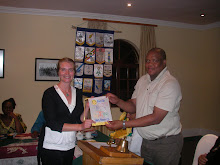
I am very impressed with the humanitarian work done in Swaziland by Rotarians.  Rotary clubs here are small, but effective.  The Malkerns club, one of the smallest with 15 members, has the most matching-grant projects in the district, and recently reached 4,700 children with clothing and blanket distributions.  Often times Rotarians step in when the government does not provide services. 
My host club of Mbabane-Mbuluzi along with their Rotaract club has identified a school without desks where children stand and use the wall and floor to put their books and notepads on.  A rousing debate occurred last week at the meeting where Rotarians discussed their role in education.  If the government is not fulfilling their responsibility to the people, should Rotarians step in to help?  The Rotarians are incredibly concerned about education and the situation in these schools, but they know that they cannot start acting on the government’s behalf.  Do they step aside and push the government to provide the services they should?  What about these children now with inadequate access to education? 
A political atmosphere of rampant corruption makes the Rotarians job very difficult.  One Rotarian explained the challenge to me by saying, “Why do I pay taxes?  The taxes are supposed to be used for education, health, and other services.  But they aren’t being used for this.  Someone is becoming rich off my taxes, and now I’m expected as a Rotarian to pay for the desks, when I already paid for them with my taxes.  We cannot keep doing this.  The government will not change if we do their work for them.”                    
The country is in a financial crisis and the King just gave himself a raise equal to the entire health budget.  There will continue to be humanitarian needs as a result of government inadequacy, so the question of which projects to fund will become even tougher.  For the Swaziland Rotary clubs, the tension between a desire to respond to the acute needs of the population and a willingness to hold their government accountable and seek change will only grow tighter. 
A visiting Rotarian from the UK stood up and talked about Matching Grants and how to raise money for these projects.  He was missing the point.  The Swazi Rotarians were saying they have the money for the desks, but if they buy these desks when they should have been provided by the government, will it really be helping in the long term?  Will they be fueling a corrupt system when they should be challenging their government to deliver to the people? 
It is not easy being a Rotarian in Swaziland.  More than any other Rotary meeting I’ve been to, the ones in Swaziland are bursting with urgency and compassion.  But they always end with humor.  To close the meetings, the sergeant tells a joke…
So… a very shy guy goes into a pub on Valentine’s Day night and sees a beautiful woman sitting alone at the bar.  After an hour of gathering up his courage, he finally goes over to her and asks tentatively, “um, would you mind if I bought you a drink?”  She responds by yelling, at the top of her lungs, “no, I won’t sleep with you tonight!”  Everyone in the pub is now staring at them.  Naturally, the guy is hopelessly and completely embarrassed and he slinks back to his table totally red faced. 
After a few minutes, the woman walks over to him and apologizes to him and says, “I’m really sorry if I embarrassed you just then.  You see, I’m a graduate student in psychology and I’m studying how people respond to embarrassing situations.”  The man responds, at the top of his lungs, No I will not pay $200!”

The Object of Rotary


The Object of Rotary is to encourage and foster the ideal of service as a basis of worthy enterprise and, in particular, to encourage and foster:

-the development of acquaintance as an opportunity for service
-high ethical standards in business and professions; the recognition of the worthiness of all useful occupations; and the dignifying of each Rotarian’s occupation as an opportunity to serve society
-the application of the ideal of service in each Rotarian’s personal, business and community life
-the advancement of international understanding, goodwill and peace through a world fellowship of business and professional persons united in the ideal of service

The 4-Way Test
Of the things Rotarians think, say and do:
1.       Is it the truth?
2.       Is it fair to all concerned?
3.      Will it build goodwill and better friendships?
4.      Will it be beneficial to all concerned?

The Object of Rotary and the 4 Way Test are said at every Rotary meeting.  Whether you are in Hong Kong, India, Swaziland, the US, Canada, Honduras, these doctrines guide your life as a Rotarian.  I enjoy this time at meetings.  It is unifying and reminds me that whatever we chose to do, whatever skills and connections we have, there is always an opportunity to use them to serve one another.  I am thankful for this weekly reminder.  It puts into perspective why I am in Swaziland and refreshes me for the work ahead.


Tuesday, March 29, 2011

Buyani’s Got Soul


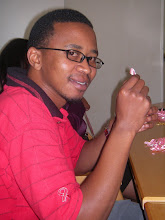
Soul.  That’s what this 26 year old Rotaracter says is his favorite part of being a Swazi.  “You feel like you’ve known another Swazi forever…  there’s just a connection, even if you’ve never met before,” he says.
Buyani- you’ve said it best.  My first real introduction to the Rotaract club of Mbabane-Mbuluzi was on a three day retreat where I was the only non-African.  By the end of the three days, it really was like we had known each other forever.  The hospitality, warmth, and “soul” of the Swazi people are a main draw to the Kingdom.
Buyani Fakudza was one of the founders of the Rotaract club of Mbabane-Mbuluzi.  Rotaract is like Rotary, but for young adults.  Buyani’s first introduction to Rotaract was as a university student, where he majored in GEP (geography, environment, and planning).  From his first meeting, Buyani was hooked and after graduation, attended the Manzini Rotaract club where he was president.  Commuting to Manzini became taxing and Buyani saw the need to start a club where he lived, in Mbabane, so start a club he did! 
Currently, Buyani works as an Assistant Geologist for the Ministry of Natural Resources and Energy.  Recently a blaring headline in the Swazi Times stated the IMF recommended civil servants in Swaziland should not paid due to the extreme financial crisis gripping the country.  In fact, there is only enough in the natinal budget to pay civil servants for three more months.  Buyani seemed concerned about this, as a civil servant, but stated this is not a new issue.  Recommendations like this have happened in the past, but there always seemed to be a solution at the last minute, and civil servants were paid.  Will it work this time?  How can you run a country without civil servants?  Why work for the government at all, if this is a fairly common threat?
I sit across a calm, but firm Buyani, who argues that despite these issues, the government still has the best job security, good pay, and options for advancement and further education than a job in the private sector.  But he also holds his government responsible for the financial mismanagement and asks hard questions about priorities and budgets.  I wish I wasn’t the only one hearing his honest and intelligent assessment of the issues his country faces and areas where government needs to be more responsive.
You find that it’s in his nature to work hard and be concerned about the welfare of others.  From the choice of his major, to his work as a secondary school teacher and football coach, to his involvement in Rotaract and an NGO called REASWA (renewable energy association of Swaziland), Buyani embodies the Rotary commitment of service above self. 
As I quiz Buyani about his hobbies I realize that we have more in common than we are different.  He likes reading, sports (soccer), and traveling.  I ask, “Where do you want to travel?” 
            He replies, “All over Africa.”  Hmmmmmm.  Anyone else seeing where my mind is going?
            His favorite book is “I Read What I Like” by Steve Biko, the man known for developing Black Consciousness during apartheid.  His favorite food?  Emasi, which is sour milk which is usually eaten with stiff porridge.  O.K., now I’m starting to see some differences between us!  Emasi and ligusha are the two Swazi foods that I don’t do well with. 
We continue our conversation, I learn that Buyani has never been on an airplane.  Really?  Hmmm, we just might have to fix that.  Buyani, my brother from another mother, I am so glad that I met you during that crazy weekend at Mlawula, and that you have continued to befriend me and share your Swazi soulful nature. Ngiyabonga kakhulu umngani wami.

Friday, March 18, 2011

Multi Purpose Vuvusela


You may remember the vuvusela from the World Cup.  At least I know my grandmother does- she watched the entire World Cup with the sound down, as these popular horns were too irritating for her to listen to. 
I’ve seen my share of crazy vuvusela’s in Swaziland.  I’ve seen beaded ones, giant ones, and ones used by companies as a marketing tools.
Before Christmas, I went to a Rotary sponsored Christmas Carol Night where Rotarians sang carols and had gifts for children at a local orphanage.  I nearly died when Santa emerged with, you guessed it, a vuvusela!  No one batted an eye, except for me, who was laughing hysterically at the back.  I suppose that sleigh bells aren’t really relevant in a place with no snow, so why not a vuvusela?  The South African flag was painted on it, so it was actually red and green- how perfect! 
            Christmas time was a bit challenging for me in Swaziland this year, as so many of our traditions in the US aren’t really celebrated here, and Swazis don’t have a lot of their own traditions.  But celebrating with Rotarians, singing carols, and meeting up with them for a lunch and afternoon of fun/crazy games helped me celebrate.  At first I thought, how can I celebrate without my family, with no stockings, and when it’s hot?  I guess the answer is, you bust out a vuvusela!  Kisimusi lomuhle- Merry Christmas!

Thursday, March 17, 2011

How We Roll


My first day of data collection made all of the stress, work, and anxiety of the last year totally worthwhile.  In fact, the whole month of data collection went off almost flawlessly and put a lot of things in perspective.  All the work I put into the research and moving to another continent seems incomparable to that experience.
        I was blessed with a charismatic and hard-working team of data collectors, and we went all over Swaziland together.  When I worked with the RHMs (the population I was surveying in my study) as a Peace Corps Volunteer, I had an impression of their work and their burden, which prompted the study.  But as the time neared when the study would actually take place, I started to worry.  Am I, as a foreigner missing the point?  Are my impressions off?  Am I doing this study for nothing?  Will there actually be a change coming out of the work I am doing? 
        All of those fears came to rest when I went to a preparation meeting where I asked the RHMs if anyone had ever asked how they were doing.  All 100 women responded loudly, “Kute!” which means that no one had.  Countless times when we were surveying the RHMs, they came up to me afterwards and thanked me for coming, for caring, for paying attention to their needs.  Participants called me “Sibusiso” meaning blessing, or gift from God. (Now, this could have been because all of the participants received an incentive of E25!)
        Apart from the satisfaction of doing something meaningful, it was extremely fun and an incredible learning experience  going out every day with my team to do the research.  I rented the University kombi (15 seater van) and met half of the team at the University.  Mary, one of the data collectors, insisted we pray before leaving.  The driver would even turn off the engine while we prayed for a safe journey and successful work.  If we forgot to pray, Mary would remind me, and the driver would pull over on the side of the road so we could pray.
        We would pick up two more data collectors along the road, and met the final group in Manzini, and then proceeded to wherever the destination was for the day.  It usually took us more than an hour to get to our destination, and in some cases it took 2.5 and up to 3 hours because we went to very remote places.  When the data collectors asked why we were going so far, I always remembered my experience of being a frustrated Peace Corps Volunteer in Mambane, which was so remote, most NGOs would not come to help me on projects.  I didn’t want to be like them! 
        The long journeys felt like a mini road trips, and afforded me the opportunity to have long discussions with the data collectors.  It was cool seeing them get into the research.  Some of them discovered they have a natural aptitude for research and community work.  Many of the data collectors were from urban areas, and it was interesting seeing how much they learned about the challenges in their own country, and as always it was a wonderful learning experience for me too. 
They were also incredibly patient with me, as it can be challenging to design and implement a project in another country and culture.  I never knew exactly where we were going, and relied heavily on our driver to get us places.  Misunderstandings occurred, including forgetting to tell the research team that we were headed to an umphakatsi (the chief’s place), where certain attire needs to be worn.  This made the women scramble at the last minute to find cloth to cover their pants and their heads with.  Opps!  They were yelling, “you didn’t tell us!” and answered, “I didn’t know!”  Afterwards we all had a good laugh.
        Surveying 930 participants in one month all over Swaziland was exhausting, and we often had to change our plan on the fly and be flexible.  I have learned a great deal about communication, flexibility, and perseverance.  Most of all, I learned to listen.  The data we collected was at times very sensitive information, including illnesses (many had HIV) and depression.  We asked about their sex life and other personal questions.  So I really wanted to make sure participants were surveyed in as confidential setting as possible.  I knew that most of the time the surveys would be done outside, under a tree, and you can’t always control if people walk past.  But I was determined to make the settings as confidential and consistent from place to place to make sure the data was valid.
         But I learned a remarkable thing about Swazi culture verses American and Western culture in this respect.  On the very first day, the data collectors started to interview 2 participants at once.  I quickly told them to stop and do them individually because I was afraid that participants would not feel comfortable being completely honest with another participant listening in.  A data collector pulled me aside and said that the participants had asked to go together.  Not only does it save time, but doing a survey was new to them, so they felt more comfortable doing it with a familiar person.  When I brought up confidentiality, the data collector stated that he asked the participants, and they said that they all know about each other anyway, and that they don’t have a problem.  I was skeptical.  Are they really going to be honest?  Will my data be valid?
         I could see that this was something the participants had asked for, so I allowed them to be surveyed in groups.  I asked the data collectors afterward, and they responded that many participants were open and reported HIV+ statuses, and that they found that they were more honest in the groups.  What they found was that the participants knew each other so well, that they would call each other out if they were lying!  How remarkable! 
         This example and many more taught me that while I had graduated from university and had experience in research, my data collectors were experienced in ways I was not.  I learned to listen and change my perspective based on their recommendations.  I felt there was a healthy give and take among us where we questioned and pushed each other to make the study better and more relevant. 
As is almost always the case, I learned much more from my Swazi counterparts than I taught them, even if I was the “boss” of the research.  I know I have been enriched by this experience and I hope they were too.  Who knew research could be this fun?

Monday, March 14, 2011

Data Collection


Data collection: November 2010

Nuts and Bolts:
-11 Swazi data collectors
-11 days of data collection
-900 participants surveyed
-13 sites: 11 Tinkundla, 3 clinics, all 4 regions of Swaziland
-sites included:
Hhohho region: Mbabane East and West Tinkundla, Mhlaganatane Inkundla, Mahwalala Red Cross clinic
Manzini region: Manzini North and South Tinkundla, Mafutseni Inkundla, Ludzeludze Inkundla, Sigombeni Red Cross clinic
Lubombo region: Siphofaneni Inkundla, Dvokodvweni Inkundla (met at the Malindza Umphakatsi)
Shiselweni region: Shiselweni II Inkundla, Sandleni Inkundla, Silele Red Cross clinic

Description:
Participants were Rural Health Motivators and Care Facilitators in Swaziland.  RHMs and CFs are community care-givers.  We surveyed them during their monthly meeting.  I randomly selected sites, choosing 2 per region for the RHMs.  For the Red Cross Care Facilitators, we went to the 3 Red Cross clinics in Swaziland, in the Hhohho, Manzini and Shiselweni regions.  The goal was to survey 100 RHMs during each meeting, totaling 800 RHMs.  There are 200 CFs in Swaziland, so our goal was to survey as many of them as possible.  The grand total being 1,000 participants.

Since not all of the participants are literate, I hired data collectors to read the questions to each participant and assist them in filling in the answers.  I held a training for the 11 data collectors before going out to do the surveys.  A good part of the training was held in siSwati!